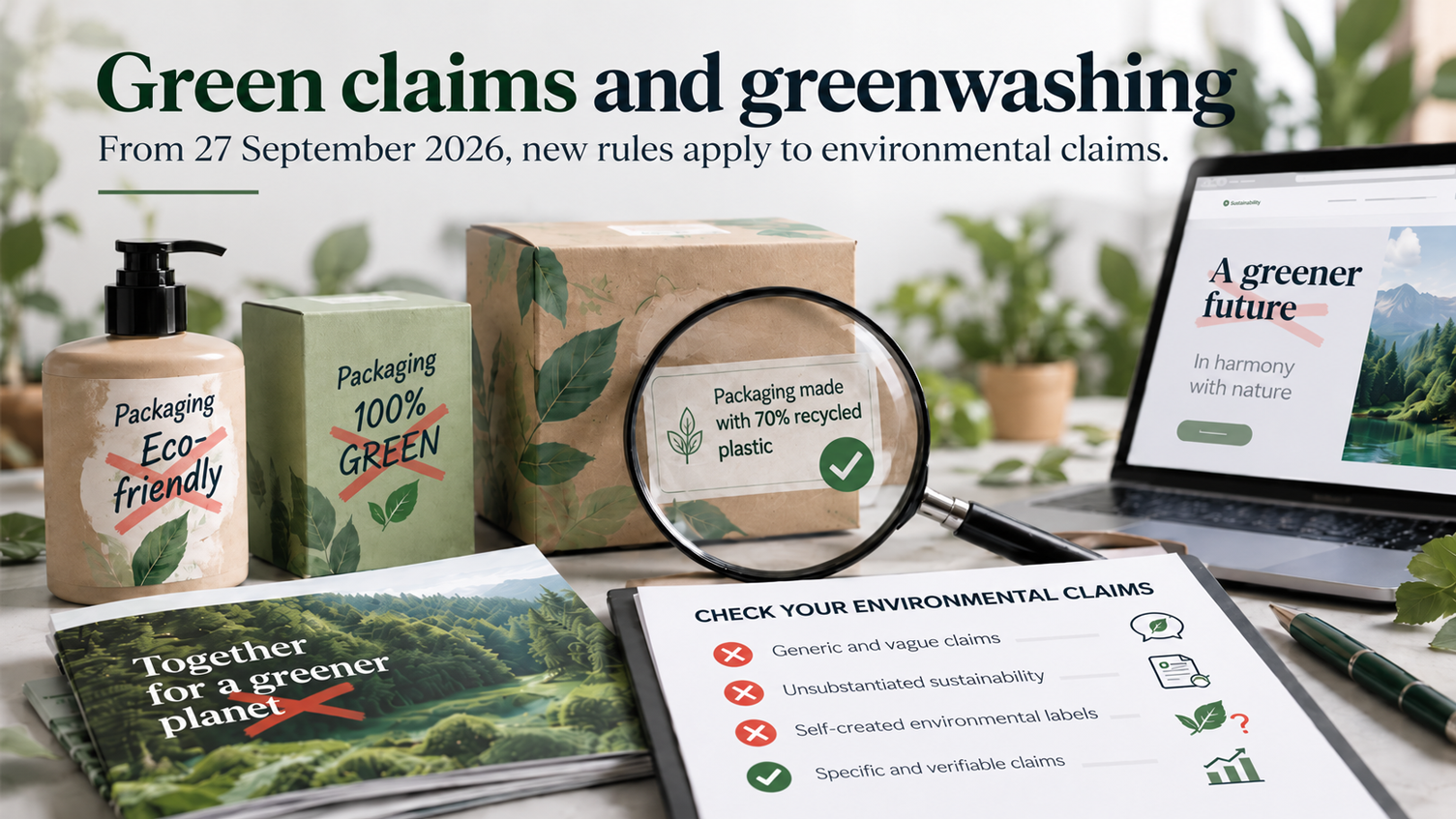
On 27 September 2026, Italian Legislative Decree No. 30 of 20 February 2026, transposing Directive (EU) 2024/825 – Empowering Consumers for the Green Transition – entered into force in Italy, introducing significant changes to the rules governing environmental communications.
The legislation establishes restrictions and prohibitions on sustainability claims appearing on product packaging or advertising materials, with the aim of combating greenwashing and ensuring greater consumer protection. Greenwashing refers to practices intended to make products, services or companies appear more environmentally friendly than they actually are through misleading, unclear or unsubstantiated statements.
The new provisions therefore require companies to carry out a careful and thorough preliminary assessment of all promotional claims, whether they appear on labels, packaging, websites, social media channels, catalogues, brochures or other marketing materials.
Generic environmental claims: What is changing?
One of the main changes is the prohibition of generic environmental claims that are not supported by demonstrated and recognised excellent environmental performance.
In particular, broad expressions such as:
- “green”
- “ecological”
- “eco-friendly”
- “environmentally friendly”
- “respectful of the environment”
- “biodegradable”
- “climate friendly”
can no longer be used freely.
The Directive draws a clear distinction between generic and specific environmental claims, prohibiting generic claims that do not meet the applicable requirements and establishing specific conditions for acceptable claims.
1. Generic environmental claims (Prohibited)
This category includes vague or general statements that do not specify the environmental benefit in a clear and prominent manner on the same communication medium.
An expression such as “environmentally friendly packaging” is a typical example of a generic claim and is no longer permitted under the new rules unless the relevant legal conditions are met. Generic terms such as “green” or “sustainable” should therefore be avoided when used without appropriate qualification and substantiation.
2. Specific environmental claims (Permitted)
By contrast, a statement such as “100% of the energy used to manufacture this packaging comes from renewable sources” is an example of a specific environmental claim.
This type of statement clearly and precisely identifies the particular environmental characteristic or benefit being communicated. To comply with the legislation, the claim must always be accurate, truthful, objectively substantiated, verifiable and non-misleading.
Sustainability labels and logos: An end to self-declared green labels
The new rules also introduce strict restrictions on sustainability labels and logos.
In particular, the use of labels, marks or symbols suggesting that a product or company has superior environmental or social sustainability characteristics is prohibited unless they are established by public authorities or based on a certification scheme that meets the applicable legal requirements.
For this reason, companies must carefully assess all internally developed environmental logos used on packaging or in promotional initiatives.
Even a simple graphic accompanied by expressions such as “Green Product”, “Eco Choice” or “Sustainable Choice” may fall within the scope of the rules governing sustainability labels.
“Carbon neutral” claims and carbon offsetting
A key aspect of the new legislation concerns claims relating to greenhouse gas emissions.
In particular, the legislation prohibits presenting a product as having no environmental impact, a reduced impact or a positive environmental impact in terms of greenhouse gas emissions when such claims are based on carbon offsetting.
Examples of claims specifically addressed by the Directive include:
- “climate neutral”;
- “CO₂ neutral”;
- “carbon positive”;
- “climate net zero”;
- “climate compensated”.
The Directive draws a clear distinction between the actual, direct reduction of a product’s environmental footprint and the use of external offsetting mechanisms.
Consequently, claims suggesting that a product has no climate impact or is climate neutral are no longer permitted when such statements are based on offsetting greenhouse gas emissions.
Offsetting mechanisms are environmental and financial instruments through which companies or organisations seek to balance their emissions by financing external projects aimed at reducing or removing CO₂ from the atmosphere.
The legislation does not prohibit organisations from communicating their investments in environmental projects or carbon credits. However, such information must not lead consumers to believe that the product itself is climate neutral or has no climate impact as a result of those offsets.
Environmental benefits must genuinely relate to the product
The new provisions expressly prohibit extending an environmental benefit relating only to a specific component to the entire product.
For example, describing an item as “made from recycled materials” when recycled materials are used only in its packaging constitutes a non-compliant practice.
In such cases, the communication must clearly identify the relevant component, using specific wording such as “packaging made from 70% recycled plastic”.
Similarly, an environmental improvement limited to a single manufacturing facility or a specific process cannot be presented as an achievement applying to the company’s entire operations.
A legal requirement cannot be presented as a green claim
Particular caution is also required when communicating environmental characteristics arising from legal obligations.
The Directive prohibits promoting compliance with a legal requirement applicable to all products within the same category on the European Union market as a distinctive feature of a particular product.
In other words, a company cannot present a legal obligation shared by all competitors as its own “voluntary commitment to sustainability”.
Recommended actions for businesses
In light of the application of the new rules, companies should carry out a systematic review of their existing environmental communications.
In particular, compliance should be assessed for:
- Packaging and labels;
- Websites and e-commerce platforms;
- Catalogues and brochures;
- Advertising campaigns;
- Social media posts and communications;
- Sustainability labels and proprietary logos;
- Claims relating to recyclability, recycled materials and packaging reduction;
- Claims relating to CO₂ emissions;
- Statements concerning future environmental objectives.
This review should not be limited to checking whether supporting documentation is available. It is equally important to assess how consumers are likely to interpret the message and whether the claimed environmental benefit accurately reflects its actual scope.
The new provisions do not prohibit companies from communicating their environmental achievements, but they establish stricter criteria for doing so.
The regulatory direction is clear: companies must move away from vague environmental slogans and towards precise, verifiable information that directly relates to the product or activity concerned.
It is therefore essential for businesses to integrate regulatory compliance assessments into their marketing strategies, ensuring that green claims are validated before publication or before the relevant packaging is placed on the market.
Trusticert S.r.l. can support companies in the regulatory review of packaging, labels, environmental claims and commercial materials, identifying potentially non-compliant communications and assessing the appropriate wording of environmental statements.
For further information, please contact: regulatoryaffairs@trusticert.com.